
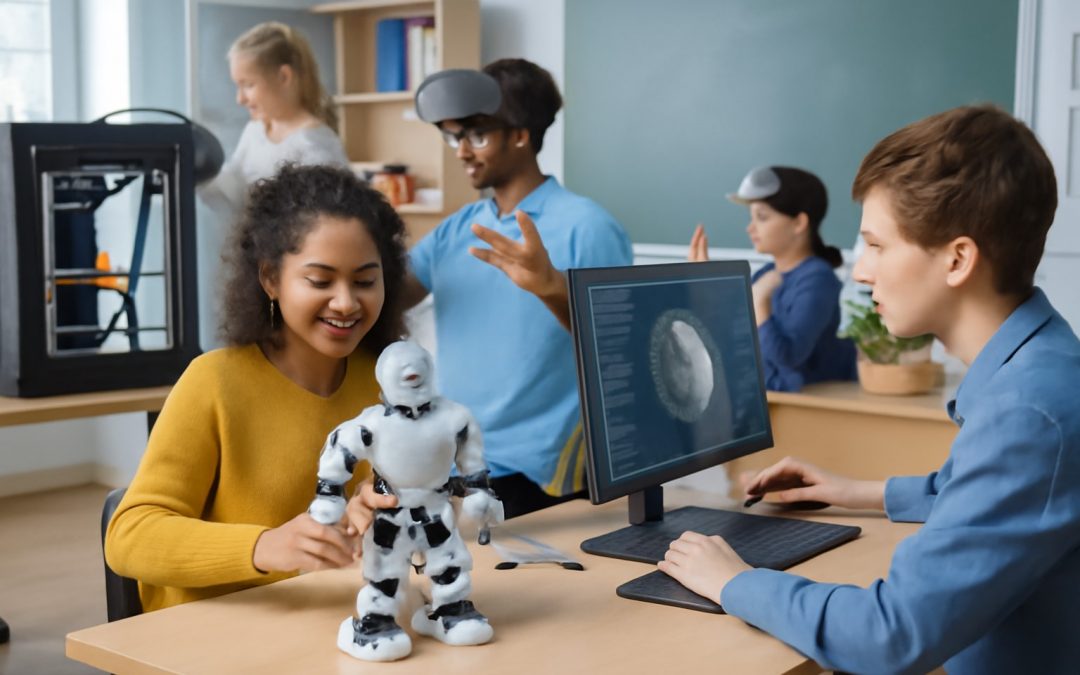
STEM education (Science, Technology, Engineering and Mathematics) has been a cornerstone in the development of the skills needed to tackle the challenges of the 21st century. As technology advances at a dizzying pace, digital tools have been integrated into teaching methods, transforming the way students engage with knowledge. Emerging technologies, such as artificial intelligence (AI), augmented reality (AR) and 3D printing, are redefining the possibilities of learning, creating immersive and personalised experiences that help students develop critical and creative skills. This article explores how these innovations are shaping the future of STEM education, providing new opportunities for both students and educators.
Artificial Intelligence: an ally in personalised learning
Artificial intelligence is establishing itself as a crucial tool in the field of education. According to a report by Stanford University, the AI market in education is expected to reach a value of $20 billion by 2027. This technology enables more personalised teaching, adapting to each student’s learning pace and cognitive style. For example, platforms such as Knewton or DreamBox use algorithms to analyse students’ performance and tailor content to their needs, thereby improving both knowledge retention and interest in the subject.
AI also enables the automation of administrative tasks, freeing up teachers’ time so they can focus on teaching. Tools such as educational chatbots help answer questions instantly, providing students with constant support without the need for the teacher to be present at all times.
Augmented reality: breaking down geographical and physical barriers
Another technology that is revolutionising STEM learning is augmented reality. Through devices such as smart glasses or mobile apps, AR enables students to interact with three-dimensional content in real time. This is particularly beneficial in complex subjects, such as biology, where students can explore 3D models of human organs or molecules, enhancing their understanding through direct interaction.
Furthermore, AR is breaking down geographical barriers, as students can take part in practical activities without needing to be physically present in a laboratory. For example, Google Expeditions allows students to take virtual tours of Mars or NASA’s laboratories, which greatly expands educational opportunities beyond the confines of the traditional classroom.
3D printing: creating prototypes in the classroom
3D printing is another technology that is gaining ground in the education sector. Its use in STEM education enables students to create prototypes of their ideas, promoting active learning and problem-solving. According to a Forbes report, 3D printing is being used in over 30% of classrooms in the United States, particularly in engineering and industrial design courses.
Students can design and build models of structures or devices, experimenting with the process of creating and evaluating their projects. This approach fosters collaboration and critical thinking skills, which are essential in today’s professional world. In this way, 3D printing not only teaches technical concepts, but also helps students develop an innovative mindset.
Space exploration: asteroids and their impact on scientific knowledge
The use of emerging technologies is not limited to Earth sciences; it has also been essential for advances in astronomical research. The study of asteroids, for example, has benefited greatly from technological advances in STEM education. 3D simulations and augmented reality allow students to explore asteroids in detail, providing a deeper understanding of the origin of the solar system. Space missions investigating asteroids are increasingly being integrated into educational programmes, using virtual reality to transport students to the surface of these celestial bodies and help them understand their composition and the crucial role they play in the history of our solar system.
Challenges and opportunities in the implementation of technology in STEM education
Despite the obvious benefits, the integration of these technologies faces a number of challenges. One of the main obstacles is the digital divide, which affects students from different regions and socio-economic backgrounds. According to UNESCO, approximately 43% of students worldwide do not have access to basic educational technologies, which limits their ability to benefit from these innovations.
To overcome these challenges, it is crucial that education policies focus on reducing inequality in access to technology and train teachers in the effective use of these tools. Initiatives such as One Laptop Per Child and teacher training programmes in digital skills are essential to ensure that all students, regardless of their location or economic background, can make the most of emerging technologies.
The future of STEM education: innovation and global collaboration
The landscape of STEM education is changing rapidly thanks to emerging technologies. Artificial intelligence, augmented reality and 3D printing are opening up new learning opportunities, improving accessibility and personalising teaching. As these technologies continue to evolve, we can look forward to a future in which students around the world can access richer, more diverse and collaborative educational experiences. With the right support, STEM education has the potential to equip future generations with the skills needed to solve the most pressing problems of the future.
In conclusion, the integration of emerging technologies into STEM education is not only improving the way we teach and learn, but is also preparing students for the challenges of an increasingly digitalised world. Making effective use of these tools is key to ensuring that all students, regardless of their background, have equal opportunities to fulfil their potential and contribute to global scientific and technological progress.